

Filter Basics
What Is a Screen Filter?
Learn what screen filters are, how they remove suspended solids from water, and where they are commonly used in industrial applications.
A screen filter is a mechanical water filtration device that removes suspended solids by passing water through a fixed screen element. Particles larger than the screen openings are captured on the screen surface, while filtered water continues downstream. Screen filters are commonly used in drip irrigation systems to protect pumps, valves, spray nozzles, heat exchangers, irrigation equipment, cooling towers, and other water-handling systems from debris and fouling.
Common Uses for Screen Filters
- Removing sediment, sand, light algae, and organic debris
- Protecting downstream equipment from clogging or wear
- Improving system reliability in industrial and irrigation applications
- Serving as pretreatment before finer filtration or process equipment
It is important to note that screen filters are not as effective against large amounts of algae, as high volumes of organic debris can clog the filter quickly and require frequent maintenance, however, this can be compensated by switching to an automatic self-cleaning screen filter system.
Screen Filter Sizing
Screen filters sizes are determined by the number of openings per linear inch on the screen, called the mesh size or mesh number, and by the diameter of these openings. Screen filter sizes are not universally standardized, but a general relation between the mesh size and the size of the openings is that as the mesh size increases, the size of the openings decrease. For example, a screen with a mesh size of 40 means that there are 40 openings per inch on the screen which translates to openings of around 400 microns, while a filter with a mesh size of 200 would have openings of around 75 microns in diameter.
The right screen filter depends heavily on the intended application, along with the required flow rate, micron rating, water quality, pressure conditions, and maintenance expectations. For applications with heavy debris loads or continuous operation, an automatic self-cleaning screen filter may reduce labor and downtime compared to a manually cleaned filter.
References
- https://ask.ifas.ufl.edu/publication/WI009
Featured Product
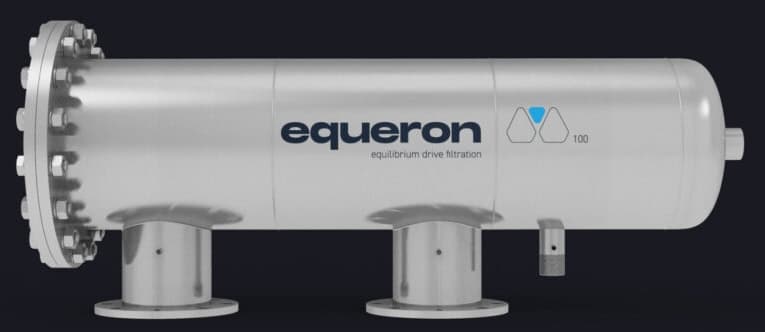
Equeron 100
Learn more